
The most dangerous DeFi transaction is often not the one that fails. It is the one that succeeds exactly as written, while the user misunderstands what was written. Transaction simulation addresses that problem by previewing likely state changes before a wallet submits a transaction—but it does not turn an untrusted website into a safe one.
That distinction matters for anyone in the United States moving between decentralized exchanges, lending protocols, NFT marketplaces, bridges, and liquid-staking applications. Rabby Wallet has become associated with a security workflow built around transaction previews, risk warnings, and multi-network awareness. The useful question, however, is not whether simulation is “good.” It is how simulation compares with older wallet habits, where its boundary lies, and which decisions still belong to the human holding the signing device.
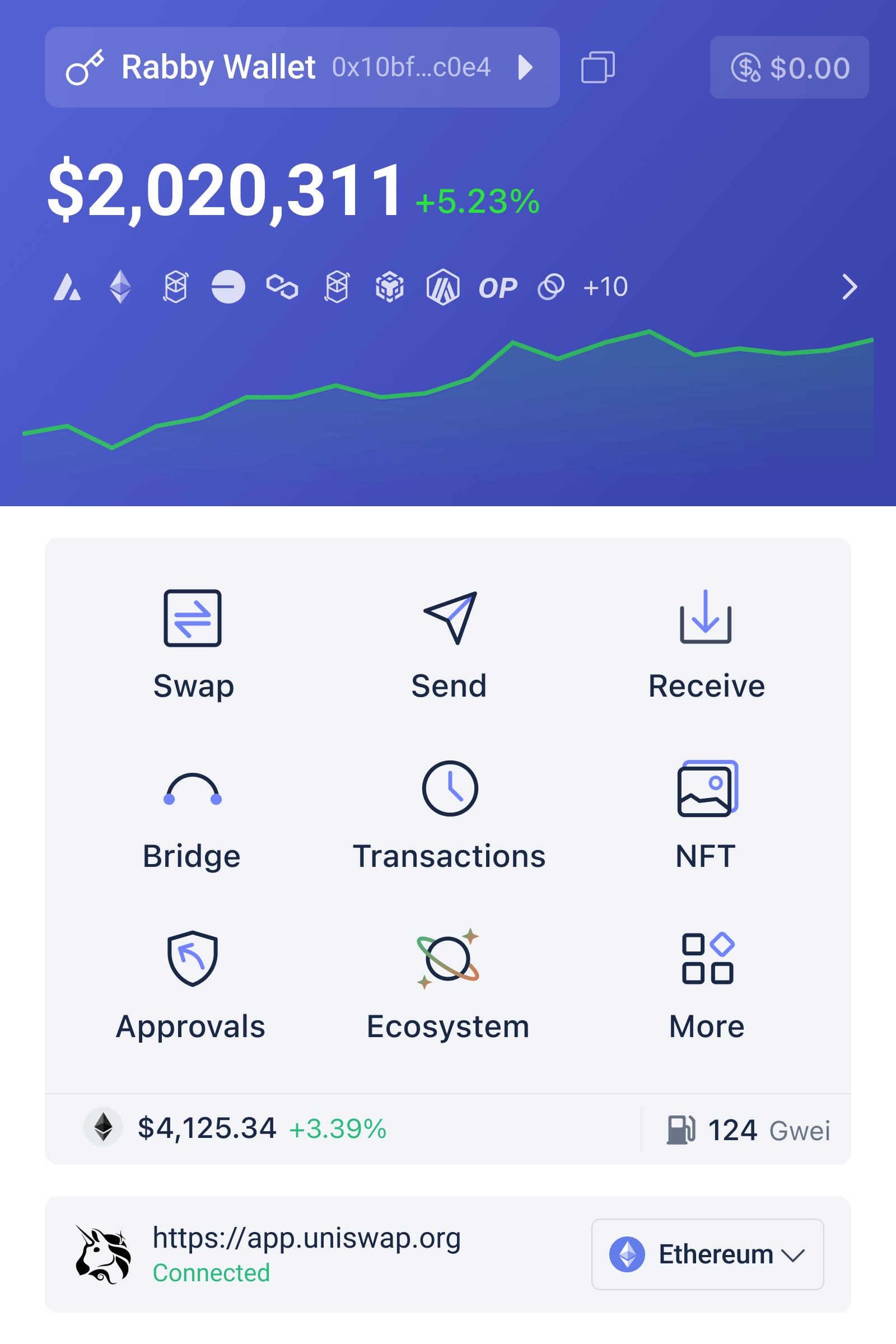
From blind signing to state-change review
Early browser wallets encouraged a relatively simple mental model: a website requested a signature, the wallet displayed technical data, and the user approved or rejected it. That model was workable for straightforward transfers, but DeFi made it inadequate. A single click can invoke several smart contracts, use token approvals, route through an exchange, or alter a position in a lending protocol. The visible button—“Swap,” “Deposit,” or “Claim”—may conceal a much more consequential sequence.
Transaction simulation changes the review from “What bytes am I signing?” to “What is this transaction expected to do?” In practical terms, a simulation runs the proposed call against a blockchain state, or a closely related representation of that state, without broadcasting the transaction as a final on-chain action. The wallet can then present probable effects such as tokens leaving the account, tokens arriving, an approval changing, or a contract interaction reverting.
This is a major usability improvement because users generally reason in assets and outcomes rather than in hexadecimal calldata. A DeFi user may not understand every function selector, but can often recognize that a supposed stablecoin swap would remove a valuable token and deliver nothing. The simulation therefore acts as a translation layer between contract execution and human judgment.
There is a deeper insight here: simulation is not primarily a fraud detector. It is an observability tool. It makes a proposed action more legible before execution. That can expose malicious contracts, incorrect network selections, excessive approvals, and ordinary mistakes. But a clear preview of a harmful action is still a warning, not a block.
Rabby versus a conventional wallet workflow
A conventional wallet workflow often places more responsibility on the application interface and the user’s own investigation. The website describes the action; the wallet displays a request; the user checks the domain, network, amount, and sometimes the contract address. This can be sufficient for experienced users interacting with familiar protocols, particularly when the transaction is simple and the contract has been independently verified.
Rabby’s simulation-oriented approach places more emphasis on expected consequences. In a side-by-side comparison, the difference is not that one wallet uses blockchain transactions and the other does not. Both ultimately depend on smart contracts, network nodes, signatures, and on-chain execution. The difference is where interpretation occurs. A traditional workflow asks the user to infer consequences from request details. A simulation workflow attempts to show those consequences directly.
The trade-off is complexity. A richer preview can reveal more information, but it can also create a false sense of completeness. Users may begin treating a green result or familiar-looking summary as a security certificate. It is not one. The simulation is based on an observed state and an assumed execution path. Blockchain state can change between simulation and confirmation, especially in active markets. A token balance, price, liquidity condition, nonce, or contract configuration may differ by the time the transaction is mined.
Simulation also cannot reliably answer every question a security-conscious user should ask. It may show that an approval will be granted, but not establish whether the recipient contract is trustworthy. It may report an expected token transfer, but not determine whether the received token is economically valuable or liquid. It may reproduce a contract call successfully while missing a broader social-engineering context—for example, a fake airdrop site persuading a user to sign a transaction that has no legitimate purpose.
Three security layers, not one
A useful framework separates wallet security into three layers. The first is identity: is the user on the genuine website, using the intended network and the correct account? The second is authorization: what permissions or signatures is the user granting? The third is execution: what state changes will the blockchain produce if the transaction runs?
Transaction simulation is strongest at the third layer and can support the second. It does not solve the first. If a user visits a convincing copy of a DeFi application, the site can request a transaction that simulates cleanly while still serving the attacker’s objective. Likewise, a signature request may not be a conventional transaction at all. Off-chain signatures, including typed-data messages used for permits or marketplace orders, can authorize future actions without immediately changing the wallet’s visible balance. A user who checks only the current asset movement may miss that future authority.
This is why wallet security cannot be reduced to “read the simulation.” The more accurate rule is: use the simulation to test the proposed outcome, then separately question the source, permissions, and economic purpose of the request.
Where simulation helps most in DeFi
Simulation is particularly valuable when a transaction has multiple moving parts. Consider a token swap. A useful preview may display the asset being spent, the expected asset received, and whether a token approval is included. That helps distinguish a normal swap from a request that transfers unrelated assets. It may also expose an unexpectedly large approval, which matters because an approval can give a contract continuing authority to spend a token under specified conditions.
For lending, simulation can clarify whether collateral is deposited, debt is created, interest-bearing tokens are received, or an existing position is altered. In a bridge transaction, it can help the user inspect which asset leaves the source chain and what the application expects to deliver on the destination chain. These are not small conveniences. They address a recurring source of loss: users understand the application’s marketing language but not the contract-level action.
Simulation is also useful for error prevention. A transaction that will revert may still consume network fees, and repeated failed attempts can be expensive on some networks. A preview that identifies a missing allowance, an invalid parameter, or an insufficient balance gives the user a chance to stop before paying for a predictable failure. In this role, simulation functions less like an alarm system and more like a pre-flight check.
But the quality of that check depends on the underlying infrastructure. Wallets typically obtain simulation results through node providers or related services. If the simulated environment is stale, incomplete, or inconsistent with the chain state, the result may be misleading. Different networks also vary in execution behavior, fee markets, finality, and support for complex applications. A workflow that feels reliable on one Ethereum Virtual Machine-compatible network should not be assumed identical everywhere.
Installation is part of the security model
For users preparing to install the browser extension, the first risk is not the first swap. It is obtaining the software from an authentic source and reviewing the permissions requested by the browser. A security feature is of little value if the extension itself is counterfeit, modified, or installed through a deceptive listing. Readers who need a starting point can review the rabby extension download resource, while still checking that the resulting installation and publisher details match the expected source.
After installation, a prudent setup separates experimentation from treasury management. A small test account can be used for unfamiliar protocols, while long-term holdings remain behind stronger controls, such as a hardware wallet where appropriate. This does not eliminate risk: a hardware wallet protects key custody, but it cannot make a malicious transaction legitimate. It may prevent remote extraction of the private key while still allowing the owner to sign away assets through a deceptive prompt.
Browser hygiene matters as well. Users should be cautious about extensions that can read or modify website content, because a compromised browser environment can alter what is displayed or interfere with a site. The seed phrase should never be entered into a website, support form, or pop-up claiming to repair the wallet. No transaction simulation can compensate for disclosure of the recovery phrase.
Rabby simulation versus manual review
Manual review remains important, but it should be understood as complementary rather than superior by default. An expert who checks the contract address, function, spender, token amount, chain, and expected output may catch details a simplified preview omits. Manual review is especially valuable for high-value transactions, unfamiliar protocols, governance actions, and signatures that create permissions rather than immediate transfers.
On the other hand, manual review is vulnerable to fatigue and interface overload. Few users will decode every request accurately during a busy market session, and technical-looking information can produce confidence without understanding. Simulation offers a more usable first filter. The best approach is therefore risk-based: use the preview for every transaction, escalate to contract and permission review when the value, novelty, or irreversibility is high.
A reusable decision rule is to ask four questions before signing:
- Is the website and network the one I intended to use?
- What assets leave, arrive, or become newly authorized?
- Does the contract or spender have a legitimate reason to perform that action?
- What would be difficult or impossible to undo if the preview is wrong?
The last question is often neglected. Reversible errors and irreversible errors deserve different caution. A failed transaction may cost a fee; an unlimited approval or permanent transfer may create a much larger exposure. The dollar amount is relevant, but so is the duration and scope of the permission.
What to watch as wallet security develops
The likely direction of wallet design is toward more contextual transaction interpretation: clearer permission summaries, better detection of unusual recipients, and interfaces that distinguish immediate transfers from future authorization. If these features improve, the practical benefit will depend on whether they reduce cognitive load without hiding important uncertainty.
The open problem is that security judgments are partly technical and partly social. A wallet can estimate execution, but it cannot independently establish that a protocol’s economics are sound, that a team will behave honestly, or that a token’s market value will persist. Users should be especially skeptical of any interface that converts a complex risk into a single reassuring color.
For now, Rabby transaction simulation is best viewed as a strong additional layer in a layered defense. It can make hidden state changes visible, catch many ordinary mistakes, and give DeFi users a more concrete basis for refusing suspicious requests. It cannot replace source verification, permission discipline, key protection, or judgment. The meaningful shift is not from unsafe wallets to safe wallets. It is from signing opaque instructions to reviewing an evidence-based forecast—while remembering that a forecast remains conditional.
Frequently asked questions
Does Rabby transaction simulation guarantee that a transaction is safe?
No. It estimates likely blockchain effects before submission. It may reveal unexpected transfers or approvals, but it cannot prove that the website, contract, token, or protocol is trustworthy. The chain state can also change between simulation and execution.
Can simulation detect every wallet-draining scam?
No. It is more effective when the risk appears as a visible state change. It may be less conclusive for off-chain signatures, complex permissions, newly deployed contracts, misleading tokens, or scams that rely on a counterfeit website and user persuasion rather than an immediately obvious transfer.
Should a hardware wallet user still review Rabby’s simulation?
Yes. Hardware wallets help protect private keys, but they do not judge whether the owner is signing a harmful transaction. A simulation and careful permission review remain useful even when the final signature is produced on separate hardware.
No comment