
A common misconception is that a wallet with transaction simulation can make DeFi transactions safe. It cannot. What it can do is make the proposed outcome more visible before a user signs, which is a substantial difference in an environment where a single approval or contract call may move assets, alter permissions, or interact with several protocols at once.
That distinction matters particularly for users in Germany and across the wider European DeFi market. Multi-chain activity is no longer limited to Ethereum: assets and applications span Polygon, Arbitrum, Optimism, Base, Avalanche, the BNB Chain, and many other EVM-compatible networks. Rabby Wallet is designed for this setting. Developed by DeBank, it combines non-custodial key management with a security scanner, broad EVM support, and a pre-signing view of expected balance changes. Its value is therefore less about being a passive container for coins and more about acting as an interpretation layer between a dApp and the person holding the key.
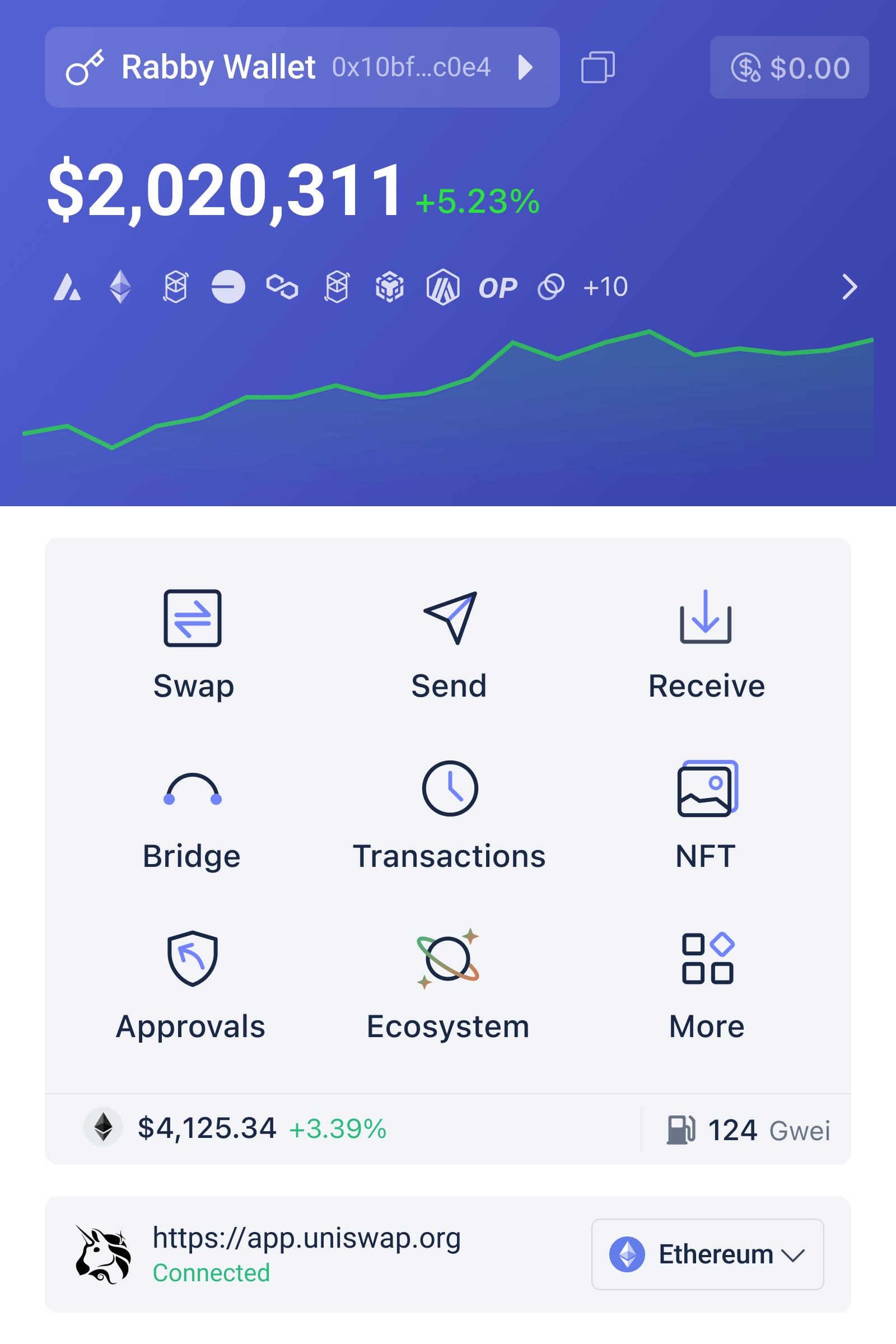
Transaction simulation is a preview, not a guarantee
When a user connects a wallet to a decentralized application, the dApp prepares a transaction request. That request may contain a contract address, method, parameters, value, and gas settings. A conventional wallet can show technical fields, but those fields are often difficult to interpret. Transaction simulation adds another step: before signing, Rabby attempts to execute the proposed call in a simulated environment and presents the expected changes to token balances and permissions.
This is useful because the important question is rarely “What hexadecimal data am I signing?” The practical question is “What should change if this transaction behaves as intended?” A swap might show one token leaving and another arriving. An approval might show a spending permission being granted. A liquidity interaction could affect several assets and positions. By translating contract execution into a balance-oriented explanation, Rabby reduces the gap between blockchain mechanics and human judgment.
The non-obvious point is that simulation improves observability, not control. It does not reverse a transaction, guarantee that the contract is honest, or eliminate dependence on external data. A contract may behave differently when mined because the market price, liquidity, block state, oracle value, or available balance has changed. A malicious interface may also present a transaction whose simulated outcome appears ordinary while relying on a later interaction or an approval that creates risk. Simulation should therefore be treated like a pre-flight check: highly valuable, but not a substitute for understanding where the transaction is going.
Myth: a non-custodial wallet removes the main security risks
Rabby follows a non-custodial model. Private keys are stored locally on the user’s device rather than being sent to Rabby’s servers. The wallet does not take possession of funds, and core signing functionality is designed to remain usable even if Rabby’s backend services are unavailable. This architecture reduces custodial exposure, but it also preserves personal responsibility. A seed phrase stored in a compromised browser profile, copied into a phishing form, or photographed by an attacker remains a critical failure point.
Rabby’s integrated security engine adds another defensive layer by checking contracts and addresses for signals associated with phishing, known exploits, or risky unlimited token approvals. These warnings are especially relevant because token approval is often misunderstood. An approval does not transfer tokens immediately; it gives a specified contract permission to spend them later, sometimes up to an unlimited amount. If that contract is compromised or deceptive, the permission can become an enduring liability.
Warnings are evidence, not verdicts. A clean result does not establish that a protocol is economically sound, that its governance is trustworthy, or that a newly deployed contract has no undiscovered vulnerability. Conversely, a warning may reflect incomplete or changing information rather than proof of malicious intent. The disciplined response is to slow down, verify the domain and contract address independently, inspect the requested permission, and consider revoking approvals that are no longer needed.
Why multi-chain convenience creates a new kind of risk
Rabby supports more than 140 EVM-compatible networks, including major Ethereum layer-two networks and alternative chains. Automatic network switching can remove a common source of user error: manually selecting the wrong chain before connecting to a dApp. Hardware-wallet compatibility with devices such as Ledger, Trezor, and OneKey can further separate transaction approval from the browser environment.
Yet convenience can hide complexity. A bridge does not merely “move” a coin in the same way that a file moves between folders. It may lock an asset on one chain, mint or release a representation on another, and depend on contracts, validators, liquidity providers, or an external routing system. Rabby’s integration with bridge infrastructure such as LI.FI can make the process easier to access, while the underlying bridge risk remains. A smoother interface changes the user experience; it does not remove the technical and counterparty assumptions of the route.
The same principle applies to the integrated swap aggregator, which can compare routes involving decentralized exchanges such as Uniswap and 1inch. A quoted “best rate” depends on execution conditions, liquidity, fees, price impact, and slippage settings. The cheapest displayed route is not automatically the safest route, and a low nominal fee can be outweighed by a poor execution price or an unnecessarily broad approval.
For more information, visit rabby wallet extension.
A practical framework for signing with Rabby
Before approving a transaction, users can apply a simple four-part test. First, confirm the network and the dApp domain. Second, identify the asset leaving the wallet and the asset expected to arrive. Third, inspect permissions separately from the immediate transfer: is the request an approval, and is the allowance larger than necessary? Fourth, ask whether the simulated outcome makes economic sense given the intended action.
This framework is reusable because it focuses on mechanisms rather than interface labels. A swap, bridge, staking deposit, or NFT interaction can look different on screen, but each still involves an intended state change, permissions, and contract assumptions. If the simulation shows an unexpected token, an unfamiliar recipient, a missing output, or a permission that does not match the task, the correct action is to stop rather than sign out of habit.
For users who regularly operate across chains, Rabby’s Gas Account may also reduce operational friction by allowing network fees to be paid with stablecoins such as USDC when the native gas token is missing. That can prevent a frustrating situation in which funds are present but temporarily unusable. However, fee abstraction introduces its own dependency on the service and its supported conditions. It should be regarded as a convenience feature, not as evidence that a transaction or network is risk-free.
What to watch as wallet interfaces become more analytical
The recent Chrome Web Store description presents Rabby as an open-source Ethereum and EVM wallet built around a smoother multi-chain experience and protective features. Its open-source MIT-licensed architecture allows community inspection of the software, which is an important transparency property. It does not mean that every deployment, dependency, contract, or user device is automatically secure. Code visibility is strongest when combined with active review, responsible release practices, and careful user behavior.
The broader direction is clear: wallets are moving from simple signing tools toward transaction interpretation systems. If simulations become more accurate and warnings become more context-aware, users may be able to evaluate complex DeFi actions without reading raw calldata. The limiting question will be whether these explanations remain understandable and whether users learn to distinguish an expected result from a guaranteed result. Better interfaces can reduce avoidable mistakes, but they can also encourage overconfidence if their alerts are treated as automatic approval.
Rabby Points, swaps, gas funding, and other convenience features add an incentive layer to wallet use. That can make a product more engaging, but reward-seeking should never determine whether a contract deserves trust. In practice, the safest habit is deliberately unexciting: use simulation, read the warnings, verify the context, keep approvals narrow where possible, and use a hardware wallet for meaningful balances.
FAQ: Rabby Wallet and transaction simulation
Does Rabby transaction simulation guarantee that a transaction is safe?
No. It shows an expected execution result before signing and can expose unexpected balance changes or permissions. Market conditions, contract behavior, oracle data, bridge dependencies, and newly discovered vulnerabilities can still create risks that a simulation does not eliminate.
Can Rabby protect funds if the private key is stolen?
No. Rabby is non-custodial and stores keys locally, so control remains with the user. If the seed phrase or private key is exposed, an attacker may be able to sign transactions independently of the wallet interface. Secure backups, device protection, and hardware-wallet use are therefore essential.
Is Rabby suitable for users who interact with several EVM chains?
It is specifically designed for that use case, supporting a wide range of EVM networks, automatic network switching, bridging, swaps, and hardware wallets. The trade-off is that multi-chain convenience also requires users to track different contracts, fee systems, bridge assumptions, and network-specific risks.
The most accurate way to understand Rabby is not as a promise of secure DeFi, but as a tool for making proposed blockchain state changes easier to inspect. That sharper mental model is the real benefit of transaction simulation: it gives users better information at the last responsible moment, while leaving the final judgment—and the consequences of signing—with the person controlling the wallet.
No comment